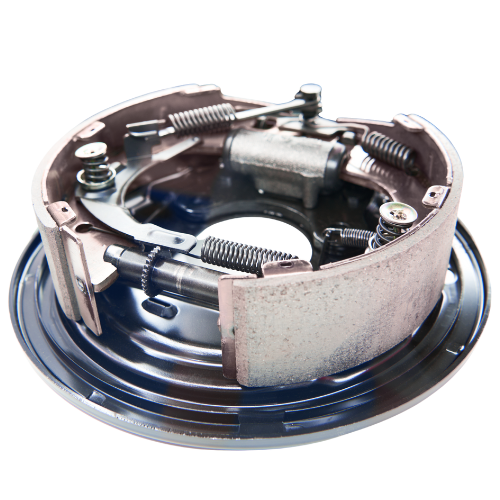
Explore the four key components that make up a truck’s brake system—engineered to ensure safe, reliable, and powerful stopping performance on every road.
The global economy moves on wheels, and the seamless transport of goods is fundamentally dependent on the massive, dedicated truck fleets operated by specialized logistics corporations. These companies navigate complex cross-border regulations, manage enormous maintenance infrastructure, and invest billions in vehicle technology. The operational efficiency of these giants—their ability to keep trucks moving—is intrinsically linked to the reliability of every component, down to the smallest part of the air brakes system. Understanding their scale, focus, and challenges highlights why component quality is a non-negotiable factor in modern trucking.
Known For: FedEx Freight is the largest Less-Than-Truckload (LTL) freight carrier in North America by revenue. It is specifically known for its integrated road network that provides reliable, guaranteed LTL services, leveraging the strength of the broader FedEx brand for extensive geographical coverage.
Owner & History: Founded by Frederick W. Smith in 1971, the company initially focused on air express. FedEx Freight, formed through a series of acquisitions including Viking Freight, has grown into the LTL powerhouse it is today. It is a publicly traded company (NYSE: FDX), headquartered in Memphis, Tennessee.
Slogan/Motto: We put safety above all (Current)
Current Status: The company is currently focused on maximizing efficiency within its distinct Freight and Ground networks as part of a strategy to improve profitability and streamline operations. This involves substantial investment in its fleet and terminal infrastructure to manage high-volume LTL loads with precision.
Challenges in Relation to Parts:
Known For: J.B. Hunt is one of the largest transportation logistics companies in North America, primarily known for pioneering the concept of intermodal transportation—using both rail and road and for operating one of the continent's largest dedicated contract services (DCS) fleets.
Owner & History: Founded in 1961 by Johnnie Bryan Hunt and Johnelle Hunt in Arkansas, the company began with only five trucks and seven trailers. It grew rapidly by capitalizing on the intermodal concept in the 1980s. It is a publicly traded company (Nasdaq: JBHT), based in Lowell, Arkansas.
Slogan/Motto: "Driven for You™"
Current Status: J.B. Hunt continues its expansion of its intermodal and dedicated services, placing heavy reliance on the consistency and reliability of its massive tractor fleet. It invests heavily in technology to optimize the transition between rail and road, making the truck itself the crucial link in the final mile delivery.
Challenges in Relation to Parts:
Known For: XPO is a top-tier asset-based LTL carrier in North America, known for its strategic focus on technology integration (dubbed "LTL 2.0"). The company utilizes proprietary data science and machine learning to maximize network efficiency, terminal throughput, and delivery consistency.
Owner & History: Originally founded in 1989, XPO was transformed by Brad Jacobs through a rapid series of acquisitions beginning in 2011, culminating in its current structure as a pure-play LTL service provider following major spin-offs in 2022. It is publicly traded (NYSE: XPO), headquartered in Greenwich, Connecticut.
Slogan/Motto: "Let's Move the World Forward"
Current Status: XPO is heavily engaged in an aggressive long-term investment strategy to boost its capacity, including opening new terminals and adding thousands of new tractors and trailers to its North American LTL fleet. Its current status reflects strong profitability driven by technology-led efficiency gains.
Challenges in Relation to Parts:
Known For: Knight-Swift is the largest Truckload (TL) carrier in North America. It is known for its massive scale, its focus on efficiency across diverse services (including dedicated and intermodal), and its ability to consolidate and optimize large-scale trucking operations following major mergers.
Owner & History: Knight Transportation was founded in 1990 by four cousins (the Knight family) in Phoenix, Arizona. Swift Transportation was founded in 1966. The two companies merged in 2017 to form Knight-Swift Transportation Holdings (NYSE: KNX), creating the largest US truckload company.
Slogan/Motto: Delivering More than you expected.
Current Status: The company is managing a large, standardized fleet structure across its subsidiaries, providing immense buying power for vehicles and parts. Their current focus is on maximizing utilization rates and reducing operational costs in a volatile freight market.
Challenges in Relation to Parts:
Known For: C.H. Robinson is one of the world's largest Third-Party Logistics (3PL) providers and is the dominant technology-driven non-asset-based road freight company. It is known for orchestrating vast shipping volumes using a network of over 90,000 contracted carriers rather than owning a majority of the trucks itself.
Owner & History: Founded in 1905 by Charles Henry Robinson in North Dakota, the company evolved from a wholesale produce brokerage to a major transportation brokerage firm, leveraging technology to connect shippers with carrier capacity globally. It is publicly traded (Nasdaq: CHRW).
Slogan/Motto: C.H. Robinson delivers logistics like no one else™
Current Status: The company's status remains strong, driven by its proprietary technology platform which uses AI to optimize routes and capacity across North America. The current challenge involves navigating volatile market pricing while maintaining the quality of service provided by its massive external carrier base.
Challenges in Relation to Parts:
The massive scale and relentless operational demands placed on these top trucking firms underscore a universal truth: reliable truck components are the foundation of global logistics. The largest road carriers, validated by industry leaders such as Transport Topics as the premier logistics and LTL providers, cannot sustain their market positions if their fleets suffer from avoidable maintenance failures.
GAPASA is dedicated to manufacturing high-quality, durable brake system parts that meet the severe requirements of these operations. As experienced truck brake calipers manufacturers, we understand that longevity and performance directly translate into reduced operational complexity and risk for any large fleet. By providing reliable brake calipers and precision-engineered assemblies, GAPASA ensures that the backbone of global commerce remains strong, reducing unexpected downtime and supporting the seamless flow of freight that these five logistics giants manage every day.
The operational continuity of the world’s leading trucking corporations, profiled here as premier LTL and TL carriers by industry sources like Transport Topics, hinges entirely upon component reliability. Their massive, high-mileage fleets demand absolute consistency from critical systems, particularly the air brakes. GAPASA supports this crucial industry by ensuring that vital parts, such as brake calipers and other components supplied as leading truck brake calipers manufacturers, are engineered for superior performance and durability, ultimately stabilizing the global supply chain against maintenance risks.