Explore the four key components that make up a truck’s brake system—engineered to ensure safe, reliable, and powerful stopping performance on every road.
Trying to understand the workings of a heavy-duty brake system can feel like learning a new language. You know it’s essential for safety, but the technical jargon, from air reservoirs to S-camshafts, often makes the components seem overly complex. For fleet managers, purchasing professionals, and logistics experts, having a clear, non-technical grasp of how these vital parts function together is crucial for effective maintenance and sourcing quality replacements.
This article is designed to be your plain-language roadmap to the truck brake system. The article will break down the fundamental concepts, explain the role of key components, and provide essential maintenance insights. By the end, you'll feel confident discussing the core of commercial vehicle safety.
Most commercial trucks rely on air brakes rather than the hydraulic systems found in typical passenger vehicles. Think of the air brake system as a fail-safe mechanism: it uses compressed air to release the brakes, and the loss of air pressure applies them. This ensures that if there is a system failure, the vehicle will still come to a stop.
Here is a simplified view of how the system operates when you press the pedal:
Understanding this basic flow is the first step in demystifying the whole process.
Every time a driver steps on the pedal, several interconnected parts work in perfect sequence to ensure a safe stop. We will focus on the three primary mechanical components that convert air pressure into friction.
The brake chamber is the powerhouse of the system, responsible for converting the air pressure signal into mechanical force. It is essentially a sealed canister with a flexible diaphragm inside.
When pressurized air enters the chamber, it pushes against the diaphragm. This action moves a pushrod attached to the diaphragm, which, in turn, applies force to the slack adjuster.

Even the highest quality brake shoes and drums wear down over time. As this wear occurs, the distance the brake chamber pushrod needs to travel to engage the brake increases. If this distance becomes too great, the brakes will not fully engage, compromising safety.
This is where the slack adjuster comes into play. It is a lever attached to the pushrod and the S-camshaft, acting as the bridge between the two.
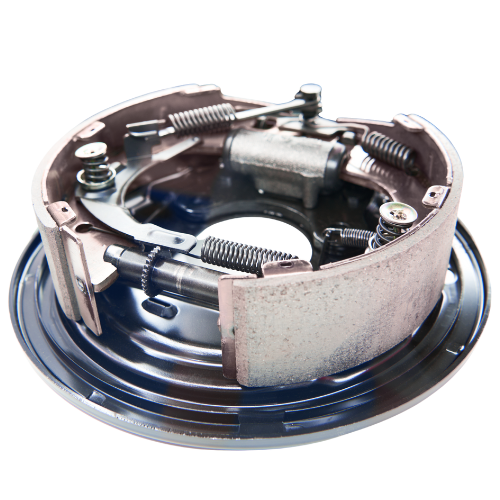
The force generated by the brake chamber and adjusted by the slack adjuster is finally delivered to the friction materials, the parts that actually rub against the wheel assembly to slow the vehicle.
When dealing with something as critical as stopping a commercial vehicle, quality is not a luxury: it is the foundation of safety and efficiency. Cheaply manufactured brake parts can lead to uneven wear, frequent failures, and increased maintenance costs over the lifespan of a truck.
This is why fleets and distributors often seek out trusted truck brake calipers manufacturers who prioritize material quality and precision engineering. A small investment in a premium component like an S-camshaft or a precise brake line bender tool can save thousands in roadside repairs and accident risk mitigation.
Routine inspection and proactive maintenance are the most effective ways to maximize the lifespan of your brake system and reduce the need for unexpected component failure. Here are some essential non-technical tips:
By consistently applying these simple checks, you can significantly extend the life of your fleet's brake systems and ensure maximum uptime.
For over 20 years, GAPASA has cemented its position as an IATF 16949-certified leader in manufacturing premium-quality truck and trailer brake parts. We understand that in the logistics and trucking industry, every component matters for both performance and safety. Our specialization lies in producing essential brake system components that meet the demanding needs of commercial vehicles worldwide.
Our manufacturing facility features advanced forging, casting, CNC technology, and rubber and plastic molding capabilities. This integrated approach ensures we maintain strict quality control from raw material to final assembly, guaranteeing consistency, durability, and precision.
We offer a comprehensive range of critical parts, including Brake Chambers (designed for reliable air-to-force conversion), highly precise slack adjusters (both manual and automatic), and durable S-camshafts (the core rotating mechanism). Our commitment to engineering excellence and responsive service has helped us build a strong and growing presence in international markets, serving fleets, distributors, and OEMs with cost-effective solutions they can rely on.
While the engineering behind a commercial vehicle brake system is sophisticated, the core concepts are surprisingly straightforward. The system is a chain reaction: compressed air activates the brake chamber, the slack adjuster fine-tunes the mechanism, and the brake shoes or brake calipers create the necessary friction.
Understanding this sequence and committing to proactive maintenance is the best way to safeguard your fleet. Prioritizing quality components, from a reliable truck brake calipers manufacturers like GAPASA to the smallest brake line bender, ensures that when your drivers need to stop, they can do so safely and reliably, every mile of the way.